

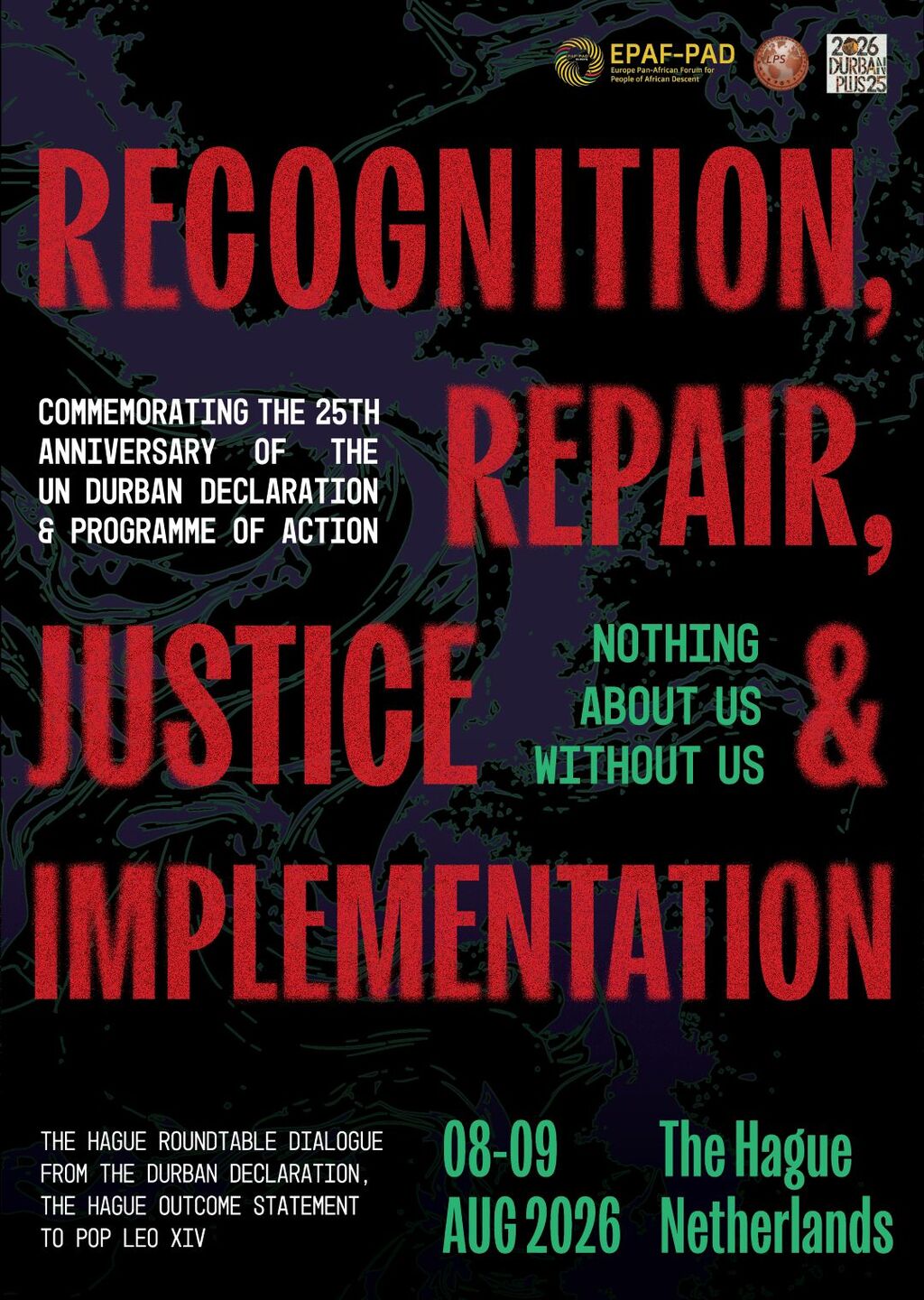
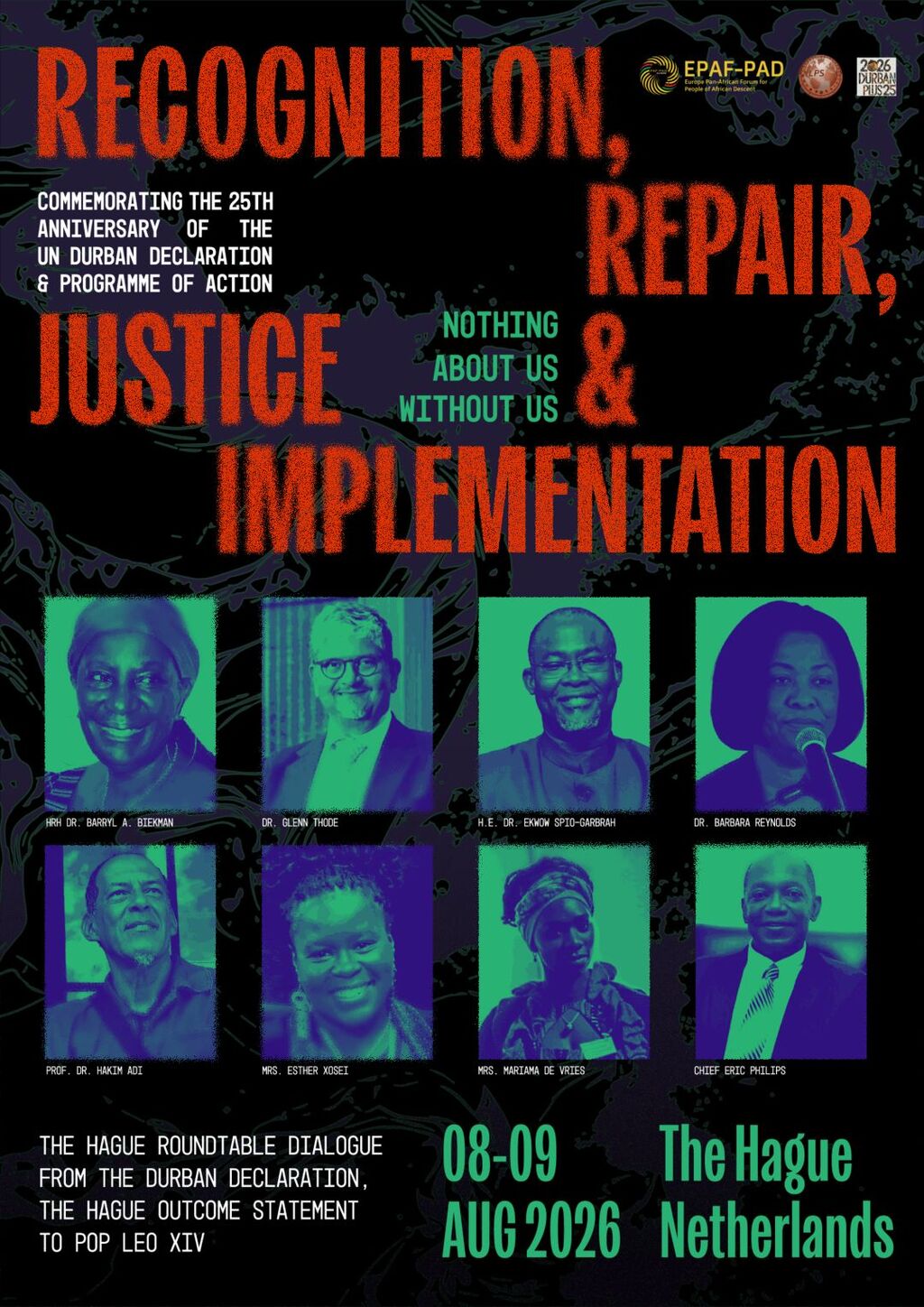
LPS 2026 DURBAN PLUS 25 RECOGNITION REPAIR
COMMEMORATING THE 25TH ANNIVERSARY OF THE UN DURBAN DECLARATION & PROGRAMME OF ACTION NOTHING WITHOUT US JUSTICE & IMPLEMENTATION THE HAGUE ROUNDTABLE DIALOGUE FROM THE DURBAN DECLARATION,
THE HAGUE OUTCOME STATEMENT TO POP LEO XIV
08-09, AUG 2026, The Hague, Netherlands
01 SIGNIFICANCE
Three Pivotal Developments
A rare alignment of openings has occurred. These openings did not fall from the sky. The UN Resolution, the shift in the Church's language, the strengthened CARICOM framework: each was influenced and catalyzed by generations of African and African diaspora organizing that predates the involvement of state actors. That organizing made this moment possible. The purpose of this convening is for the organized African Diaspora in Europe to consolidate its own shared analysis, agreed positions and coordinated power, so that it acts as protagonist of reparatory justice in Europe on its own terms, and holds states to account for the crime the Resolution names. Engagement with states and institutions is a means to repair, never the measure of it.
Three Pivotal Developments
UNGA Resolution A/80/L.48
The General Assembly formally declared transatlantic enslavement the gravest crime against humanity - shifting from conditional to indicative language for the first time.
Pope Leo XIV's Acknowledgment
The Holy See, through Magnifica Humanitas, offered its clearest acknowledgment to date of the Church's role in legitimizing slavery - opening new channels for engagement.
The Caricom Ten Point Plan on Reparatory Justice Manifesto
A framework for promoting and demanding reparations and sets out the call for reparatory justice within the context of development priorities.
02 BACKGROUND
Context and the Road to 2026
At the heart of transatlantic chattel slavery and the slave trade was the dehumanization of persons on the basis of race a social construct that to this day shapes access to fundamental human rights.
UN DURBAN DECLARATION AND PROGRAMME OF ACTION, 2001
The year 2026 marks the twenty-fifth anniversary of the World Conference against Racism in Durban, South Africa. The Durban Declaration recognized the transatlantic trade in enslaved Africans and slavery as a crime against humanity - though its practical force has since depended entirely on political will, channeled through the United Nations International Decade for People of African Descent (2015-2024). The modest results of the first Decade made a Second Decade (2025-2034) necessary.
Unga Resolution A/80/L.48-25 March 2026
Declaration of the Trafficking of Enslaved Africans and Racialized Chattel Enslavement of Africans as the Gravest Crime against Humanity
Tabled by Ghana on behalf of the African Group, supported by the African Union and CARICOM. Where Durban used the conditional ("should"), the 2026 Declaration uses the indicative ("is"), creating a formal political record to which states can be held in subsequent advocacy, diplomatic and legal processes. The advance is declaratory rather than legally binding, but decisive in one respect: where Durban used the conditional ("should"), the 2026 Declaration uses the dicative ("is"). It creates a formal political record to which states can be held in subsequent advocacy, diplomatic and legal processes.
The European states that bear the greatest historical responsibility largely abstained. Giving the Resolution practical effect within those states therefore depends in significant part on the African Diaspora communities already established there - recognized under Article 3(q) of the 2003 Protocol on Amendments to the Constitutive Act of the African Union as Africa's Sixth Region.
123 IN FAVOUR | 3 AGAINST | 52 ABSTENTIONS
03 PURPOSE
Objectives
The following six objectives guide the convening. Every strategy adopted is to be judged by whether it advances actual repair.
i PAN-AFRICAN SPIRIT
To affirm and renew the Pan-African spirit that has driven change across generations - rooted in the belief in the unity, common history and common purpose of the peoples of Africa and the African diaspora, as defined by Professor Dr. Hakim Adi.
¡¡ REPARATORY JUSTICE AS THE MEASURE
To keep reparatory justice as the objective and measure of success. An apology or declaration is a necessary step, but not the goal; the goal is reparations as set out amongst others in the CARICOM Ten-Point Plan and the UN Basic Principles (A/RES/60/147).
iii IMPACT OF RESOLUTION A/80/L.48
To present and assess the Resolution's implications for African Diaspora communities in Europe, particularly in the Netherlands, as part of Africa's Sixth Region.
iv CONCRETE STRATEGIES & STEPS FORWARD
Situational analysis and reports from the Europe Countries Facilitators: the Netherlands, Luxemburg, UK, France, Germany, Portugal, Italy, Belgium, Denmark, Sweden, Spain, Switzerland, Norway, Hungary and the Holy See; examine the concrete strategies available to the organized African Diaspora in Europe across community spaces, media, courts, institutions and parliaments. Sharing the state of action toward Reparation and Reparatory justice.
v SIXTH REGION OPERATIONALISATION
To advance the operationalization of the African Union's Sixth Region architecture, ensuring Diaspora communities in Europe are genuine co-architects of reparatory frameworks.
vi SHARED CAPACITY
To strengthen partnerships, align programmes and build shared capacity among African Diaspora organizations and their allies across Europe for the sustained advocacy ahead.
04 AGENDA
Dialogue Topics
The six dialogue topics below run across both days and are designed to build cumulative understanding, moving from a shared definition of reparations through legal and strategic analysis to concrete capacity-building.
What is Reparations?
Reparations are what is owed and what must be returned for the harms of the Maangamizi - the continuum of racialised chattel enslavement, colonialism and their continuing legacies. Those responsible, enriched by them, must repair what was damaged, restore what was destroyed, give back all that was taken, and guarantee the harms are never repeated. The plural traditions of the movement are grounded in Ubuntu and Ma'at, and hold that reparations must be defined by the peoples against whom these harms were and are committed.
Impact of Resolution A/80/L.48
Where do we go from here in Europe? Examining what the Resolution's legal architecture opens, and addressing its principal challenge - non-binding status and the doctrine of in temporality - with clear eyes and a persuasive counter-strategy, taken into account the results of the June High Level Summit in Ghana.
Strengthening Voices and Partnerships
Deepening collaboration across European African Diaspora organizations and building the shared infrastructure required for sustained, credible engagement over the decade ahead. The AU Sixth Region Diaspora in Europe Giving practical effect to rights enshrined in AU law; advancing the Sixth Region Diaspora Advisory Board; and asserting the Diaspora's standing as a self-determining political force already organizing within European states, and holding the African Union to its own commitment to the Sixth Region.
Pope Leo XIV's Apology in Magnifica Humanitas
What an acknowledgment of the Church's role - a plea for pardon, though not yet an endorsement of reparations - opens a channel to press the Church toward reparations, holding its acknowledgment to its logical conclusion.
Four Thematic Workshops
Reparatory Justice; Pan-Africanism and the Sixth Region; Ubuntu and participatory method; and Confronting Afrophobia each producing a concrete written output.
05 SCHEDULE
Programmes
DAY 1 Saturday August 2026 - Foundation and Assessment
Moderators: Dr. Angela Sayles, (Board of Directors AUADS 6th Region High Council)
Dr. Lazare Ki-Zerbo (EPAF-PAD France Chapter)
DAY 2 Sunday
9 August 2026
Workshops and Action
Moderators Dr. Nii Hammond & Mrs. Connie Arnoldus
National Reparations Commission NL
06 DEEP DIVES
Workshop Framework
Each workshop runs approximately 75 minutes with about 20 participants. They are structured to produce a specific written output - the raw material of the convening's deliverables, consolidated immediately into the Hague Outcome Statement.
07 OUTCOMES
What This Convening Will Deliver
The convening is designed to end with tangible products that participants can use immediately - not only a sense of solidarity. Each product advances the Pan-African purpose and the practical operationalization of the Sixth Region.
Pan-African Affirmation
A short statement renewing the bond of common history and purpose among the peoples of Africa and the diaspora, and affirming the European diaspora's standing as Africa's Sixth Region under Article 3(q).
Standing Coordination Mechanism
A confirmed working group of European African Diaspora organizations, with focal points, a communication channel and the date of the next meeting.
Participation and Integrity Framework
The checklist produced by the Ubuntu workshop, to safeguard community leadership in any state-led process.
Hague Outcome Statement
A concise consensus document recording shared analysis and agreed key messages, suitable for publication and transmission to partners.
AU and CARICOM Briefing Document
Carrying workshop outputs as specific, prioritized asks - including Sixth Region operationalization, reparatory-justice positions mapped to the CARICOM Ten-Point Plan, and the Afrophobia evidence-gathering plan.
24-Month Engagement Roadmap
A timeline with named focal points, beginning with the reparations movements' own community and coordination focal points, then those for engagement with the African Union (via ECOSOCC and CIDO), CARICOM and the European states concerned.
08 FOR PARTICIPANTS
Preparation
Participants are asked to come prepared - to raise the level of shared knowledge of Dutch and European policy on the Dutch slavery file, and in particular the meaning of Article 3(q) and the Sixth Region framework.
Each participant should bring concrete examples of recent developments in their own national or regional context, and should consider in advance which workshop they wish to join so that each workshop can begin its drafting promptly.
Supporting papers circulated with this note: (1) Partners in Liberation: The European Diaspora and Africa's Sixth Region - a historical brief for AU engagement; and (2) Part XVIII: The Unseen Infrastructure: Diaspora Self-Financing and the Sustainability of Pan-Africanism.
EPAFPAD - Europe Pan-African Forum for People of African Descent.
All Rights Reserved.